Showing posts with label labyrinth. Show all posts

Tuesday, 30 August 2022

Being in the Weeds

This morning, I tackled the weeds in the Labyrinth at our cottage.  The weeds seem to be taking over this year and every time I turn my back there are more of them.  You have to wonder why Mother Nature makes weeds such hardy plants that seem to thrive in even the harshest conditions?  In any case, I rather enjoy whacking them with my whipper snipper – it is satisfying work. 

That experience brought to mind a parable of the wheat and the weeds in the Gospel of Matthew which can be found here if you want to refresh your memory, https://bible.oremus.org/?ql=527923442.

In the parable, Jesus tells of a field which has been sown with good seeds – wheat.  In the night, these things seem to often happen at night, the enemy comes and sows weeds among the wheat.  The owner of the field – the master – decides to not have the weeds pulled up by his ‘slaves’.  I wonder how many gardeners would like to have someone to do the weeds pulling?  In any case, he declines the suggestion of the slave to pull the weeds because the wheat might also be pulled up in the process.  Now, I can certainly relate to that because Lorna does not trust me to weed her garden because I would most likely pull up some of the good plants as well.  Sometimes ignorance is bliss or at least a good excuse to avoid things.

So, what do we make of the parable about not pulling up the weeds because some good plants will be pulled with them?  This could make a radical approach to gardening.  However, I don’t think that was what Jesus had in mind – at least not literally.  A parable by its nature, wants to surprize and encourage the listener or reader to approach a situation in a fresh way.  Let’s consider the wheat and weeds as an aspect of ourselves, after all, Jesus was concerned about the souls of the people he came into contact with.  If the weeds are aspects of ourselves that we don’t like or those things in us that are not acceptable, the natural reaction is to pull them up and get rid of them.  As with weeds, however, every gardener knows they aren’t really gone – they will return and they seem to thrive under every and any condition. 

The human equivalent of trying to pull up the weeds – unwanted aspects of ourselves, will not get rid of them.  Those flaws and faults we know are in us will not be gone if we try and pull them up.  This is actually trying to deny them and push them out of conscious awareness.  So, what is the alternative?  What does it mean to let them grow along with the wheat?  Well, it means that we have to stop striving for perfection.  I have struggled with the idea of trying to be perfect.  Christians have been told implicitly and explicitly that we are to be perfect - it says so in the bible in the Gospel of Matthew (5: 48).  This is traditionally translated as ‘Be perfect, therefore, as your heavenly Father is perfect’.   However, an alternate translation is ‘Be all-embracing, as your heavenly Father is all-embracing.” 

When we strive for perfection, any imperfection is unacceptable and therefore something that we have to deny in ourselves.  We have to attempt to pull up the weeds and get rid of them.  We have to acknowledge them and realize they are part of us and once we do that, we can realize that God knows us better than we know ourselves and despite this God loves us.  Does that mean that we just accept our faults and whatever they are we say its okay and let it rip?  No, we need to acknowledge our faults and weaknesses and learn to love ourselves and to love our neighbours.  Richard Rohr address just this point:

To accept this teaching doesn’t mean we can say, “It’s okay to be selfish, violent, and evil.” It simply means that we have some realism about ourselves and each other. We have to name the weed as a weed. We can’t just pretend it’s all wheat, all good, because it isn’t. We’re not perfect. Our countries are not perfect. The Church is not perfect. The project of learning how to love—which is our only life project—is quite simply learning to accept this.

Be blessed on your journey to acknowledge the weeds in yourself and others.  

I acknowledge that we are on Turtle Island, the original homelands of the many Indigenous Nations who have lived since time immemorial in Canada or as many First and other Indigenous Nations
All of the lands in Canada are the subject of up to one hundred Treaties signed by the Crown in the right of Canada with these Nations.

I will only mention a few of the Nations: the Cree, Ojibway, Blackfoot, Blood, Dakota, Mig M'ag, Huron, Inuit and these lands are also home to the Metis people.


Monday, 2 October 2017

Where's Your Home

“We shall not cease from exploration, and the end of all our exploring will be to arrive where we started and know the place for the first time.” T. S. Eliot

Tomorrow, we are heading back to our other home in Parkhill, Ontario.  I am not sure whether my home is in Parkhill or here at our cottage in Prince Edward Island.  It does seem that I do have a home in both places; a foot or a heart in both camps.  This has its advantages and its disadvantages of course.  To reflect on the statement by Eliot, it does give me a great deal in my ongoing exploration of myself and my discovering who God’s created me to be which will enable me to know the place where I started. 

Whenever I think of “home” I am reminded of my visit to L’Arche Daybreak in Newmarket one reading week while I was studying theology at Huron University College.  One of the residents met me and asked the question that, as I later found out, he asks everyone he meets, “where’s your home.”   This made me stop in my tracks, figuratively and literally.  Of course, asking someone where they are from or where they live is a common why of making conversation when you meet someone.  However, “where’s your home” is an entirely different matter. 

So where is my home?  My answer to this question contains a rather big dose of irony.  Perhaps that is to be expected because questions like this and others dealing with the soul seem to always have irony in the soul.  It seems that finding that place where we started, as Eliot proposes, is really the answer to where your true home is.  You started at your true home and your exploration will involve finding out where that place is.  Therefore, you will not know where your true home is until you reach it at the end of your journey.  You have to make that exploration and after all that, you discover that it was where you left.  Your true home is with God, or the divine, or whatever name you want to give it.

Looking at my exploration so far, it did not often seem that I was travelling on a journey of exploration that would lead to my true home.  There were times when it seemed that perhaps I was on a path that would lead me there.  However, other times I seemed to be completely lost and had no idea what my destination was or even that there was one.  It had more of a feeling of a maze with many dead ends and wrong turns than a labyrinth that had a definite path to follow.  Admittedly, walking the labyrinth seems to take you away from the centre just as you approach it.  But you always know where the centre is. 

Ironically, looking back I can see a definite path my life has taken although it has been anything but a straight and narrow journey.  I do seem to be getting closer to the place where I started and can see glimpses of my true home.  I am also beginning to know in my heart that I will see it again for the first time.  That is what sustains me in those days when it does seem as if the destination or my home is receding into the distance as it does on the labyrinth walk when you approach the centre and then turn a very sharp corner and travel away from it.  However, I am beginning to realize that this too is part of the exploration. 

Blessings on your journey,


Greg 

Wednesday, 2 November 2016

Learning the Language of God

Back at the beginning of the millennium I was trying to discern if I had a call to the ordained priesthood.   I thought that it would be great to have a “Road to Damascus” experience i.e., hearing a voice from heaven perhaps with even a heavenly light show to make sure I was paying attention.  However, I can say that I did not receive a message in any way that was like that.  In the end I decided that the only way to test out a calling was to make a commitment to the journey to ordination.  Talking to fellow students during my years at Huron College, I discovered that no one had that kind of a message either.  Looking back I think that I am grateful not to have gone through what Paul experience on that road including being knocked off my mode of transportation and having scales cover my eyes for three days. 

I did receive affirmation of my decision in many ways but not specifically in a Road to Damascus way.  God does speak to us in many different ways which are not necessarily as dramatic or as clear as what Paul experienced.  One experience I had which I believe affirmed my decision occurred just after I had an interview with the Dean of Theology, John Chapman (now Bishop of Ottawa) as part of the process to enter the M. Div. program.  The interview went well and when it was finished I got into my car to drive home.  The car radio was tuned to CBC as usual and the program involved an interview with three clergy who had been ordained later in life.  This certainly fit my experience as I was in my early fifties at the time. 

This experiences was for me synchronistic—a term coined by Carl Jung.  Synchronicity is, simply put, a significant coincidence.   They can be easily dismissed by skeptics as mere coincidence and of no significance other than pure chance.  However, I understood it as a pointer from the divine that I was on the right course.  By itself it would not be enough to make a serious life-changing decision in life.  However, it was one indication that I should continue on this new path and see other signs God might send me.

I believe and have faith that God is speaking to us in many different ways today as God always has.  However, we have not been taught to recognize them.  Our culture does not generally recognize many of these ways.  We need to relearn as a culture and individuals how God does speak to us and how to interpret what might be called the language of God.  One way which I particularly favour is the language of dreams.  Dreams have been called “God’s forgotten language”—a phrase of John Sanford’s, an Episcopal priest and Jungian Analyst and also a title of his very good introduction to dream work. 

There are many other ways such as Contemplative Prayer, Lectio Divina (Holy Listening), and walking the Labyrinth.  My approach to Spiritual Direction is to help directees to identify how God is speaking to them and to help them more fully experience and understand how God is working in their lives. We are each unique children of God and so we are each more receptive to different way in which God is speaking to us.  For instance, my wife Lorna, whose primary way of receiving information is through the five senses, uses that outer input in her inner world.  She is an ISTJ on the Myers Briggs Type Scale i.e. Introverted, Sensing, Thinking, Judging. 

I, on the other hand, am not as in tune with the outer world as many who know me will attest—especially Lorna.  My primary way of receiving information is by intuition, being an INFJ on the Myers Briggs Type Scale i.e. Introverted, Intuitive, Feeling, Judging.  This difference means that we are naturally oriented differently to how God is speaking to us.  For instance, Lorna finds walking the Labyrinth to be very meaningful as a form of walking prayer.  The experience of walking the labyrinth does not resonate with me to the same extent.  Rather I find Centering Prayer to be a very meaningful way.

This does not mean that we do not use both forms as a part of our spiritual practices.  I do walk the Labyrinth and Lorna does Centering Prayer.  However, it is not the preferred method in each case.  We both pay attention to our dreams as a way of see if our lives on the course God intends for us.  We both keep dream journals and try to understand the meaning of our dreams or as Lorna says, “don’t you mean the message”? 


The most important thing in all this is to be open to how God is speaking to you and pay attention to the things that you believe God is saying.  This is not always clear and it can be helpful to have someone to help you in that journey such as a clergy person, spiritual director or counsellor.  Blessings,

Wednesday, 27 July 2016

Mazes and Labyrinths; Perfection and Union


Some time ago I wrote about the difference between a maze and a labyrinth.  I would like to continue my exploration of these to paths in the perspective of the goal of union rather than perfection.


Both the maze and the labyrinth are ancient forms which appear in antiquity.   To review, the maze which people are more familiar with, presents the person who enters it a puzzle.  The maze does provide a route through it.  It has many twists and turns and there are dead ends if you take a wrong turn.  You cannot see the path from the ground when you are trying to navigate it.  The maze often has a different entrance and exit and it you are successful you will travel through the maze.  Mazes have become very popular in recent years using various materials to create them.  The corn maze is a particularly popular form.


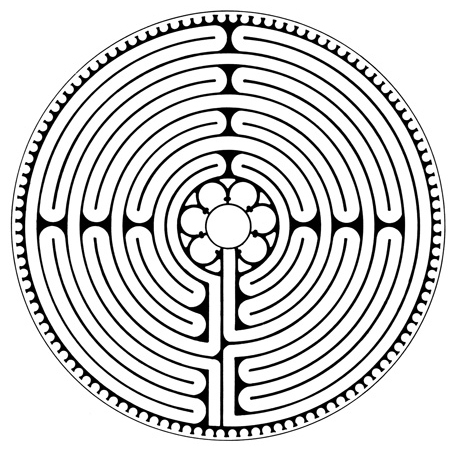
The labyrinth, which is often confused with the maze, has a similar lay out of a path to follow without seeing how it is going to end.  However, in the case of the labyrinth a path is provided which, if followed, will being you to the destination which is in the centre.  On the outward journey you follow the same path and if you stay the course you will be brought back to the place where you began. 

Image result for labrynth diagram


The approach to navigating these two forms is very different.  The maze is seen as a puzzle to be solved.  You can figure it out by trial and error or often by trying to be clever enough to solve the puzzle.  In this it is a challenge for the ego.  In many ways it reflects how we approach life—as a puzzle to be solved and a challenge to be met and won.  That unfortunate saying that was popular some years ago sums it up nicely; the one who has the most toys wins. 

The labyrinth can be understood as the representation of the spiritual journey.   It is found in many ancient cultures and has been revived in modern times and is now walking the labyrinth has become a well know spiritual practice.  It is considered a moving prayer in which we follow the twists and turns of our spiritual life to the centre and back.  Sometimes it seems we are getting close to the centre and then there is a sharp turn in our lives and we seem to be moving away from our goal.  However, if we follow the path that our savour prepares for us we will reach it even though at times it might seem as if we have reached a dead end in life. 

One way of looking at the different approaches offered by the maze and the labyrinth is the difference between perfection and union.  The maze offers us way that holds up a goal of perfection.  However, the labyrinth offers us the way of union.  Richard Rohr gives a very clear distinction between the two approaches to life:
The path of union is different than the path of perfection. Perfection gives the impression that by effort I can achieve wholeness separate from God, from anyone else, or from connection to the Whole. It appeals to our individualism and our ego. It's amazing how much of Christian history sent us on a self-defeating course toward private perfection. Union is instead about forgiveness, integration, patience, and compassion. The experience of union creates a very different kind of person.  Richard Rohr Daily Meditation July 20, 2016

Western culture has bought into the ideal of perfection to its great detriment.  Unfortunately, Christianity has walked arm in arm with our culture and encouraged Christians to try and achieve perfection.  We need to relearn again the message that Jesus showed is at the last supper that we are called to serve and not be served.  That message is truly counter cultural and radical.  It is a difficult one for us to truly learn but it is the way.  Blessings.  

Wednesday, 16 March 2016

Sermon March 13, 2016 Lent 5

19I am about to do a new thing; now it springs forth, do you not perceive it? I will make a way in the wilderness and rivers in the desert. 20The wild animals will honor me, the jackals and the ostriches; for I give water in the wilderness, rivers in the desert, to give drink to my chosen people, 21the people whom I formed for myself so that they might declare my praise.
During Lent we have been exploring our journey with Jesus as we travel to the Easter celebration by exploring ways of Spiritual Renewal.  Spiritual Renewal is a way which can help us navigate through those times in life in which we feel as if we are tottering on the edge of the pit.  It can also help us to more closely follow our Saviour each day – in the good times as well as the bad times.  
Today Isaiah declares that God will give water to God’s chosen people in the wilderness.  Spiritual Renewal calls us to different ways of drawing  on the water of salvation.  This is an echo of what Jesus told the Samaritan woman at the well:  “Everyone who drinks this water will be thirsty again, 14 but whoever drinks the water I give them will never thirst. Indeed, the water I give them will become in them a spring of water welling up to eternal life.”
Jesus tells us to draw of the water which he provides— that water of eternal life.  This is the goal of Spiritual Renewal.  The first way we explored was a method of reading scripture - Lectio Divina, Holy Reading .  This is not bible study in the traditional sense.  Rather it is a form of prayer using scripture.

We next explored walking the Labyrinth - the moving prayer in which we follow the twists and turns of our spiritual life to the centre and back.  Sometimes it seems we are getting close to the centre and then there is a sharp turn in our lives and we seem to be moving away from our goal.  However, if we follow the path that our savour prepares for us we will reach it.  Last Sunday we explored a way that God speaks to us which has been lost for many centuries—dreams which can be called God’s Forgotten Language.  Today I invite you to experience a form of prayer which also helps us draw the water of eternal life from the well; Centering Prayer.   Centering Prayer is a form of silent prayer in which you make space for you to be more aware of God’s presence in your life.  God is always there but we often have difficulty perceiving that presence.  The process is quite simple with just a few steps. 
Choose a word or phrase that resonates with you as an expression of your intent and desire - It use the word ‘return’.  Sit comfortably and upright, eyes closed, breathing naturally, and begin to repeat this sacred word silently. As your attention is focused on the desire behind the word, gradually let the word slip away; Rest in silence.  You will find that thoughts and images and feeling may come into your mind.  We are not used to quiet in our culture – our brains want to fill silence.  This has been called our monkey brains - which is very descriptive.  When these thoughts, images or sensations arise, gently return to the sacred word as a symbol of your consent to God’s presence and action within you. 

The recommended period for prayer is twenty minutes each day.  However, we will begin today with five minutes to give you a taste of the experience.  When the time is up I will close with a prayer.

Wednesday, 9 March 2016

The Prodigal People of God

During our Lenten journey I have been introducing to our congregations various ways in which we can be more open to God’s presence in our lives. We have now explored three different methods.  The first two were the Lectio Divina and the Labyrinth.  Yesterday we explored dreams as a way in which God speaks to us.  I have attached my sermon for your consideration.
 There are positive and negative images or archetypes in dreams in Carl Jung’s theory of dream work.  This is true of most, if not all things, in life.  This is also true for doing a sermon series such as we are doing during Lent.  The positive is that we can explore one subject in more depth than is often possible following the lectionary of appointed scripture in preaching.  This is true of our theme of Spiritual renewal which we are exploring during Lent.  The negative aspect of this is that we can miss opportunities to explore the scripture passages which are provided in the lectionary.  This is particularly true of the Gospel yesterday which is the parable of the prodigal son.  This parable is one that provides many possibilities of exploration in sermons and in bible study.
I want to take this opportunity to explore briefly this parable in my reflection today.  One of the best explorations of the prodigal son teaching of Jesus is by Henri Nouwen.  His book, The Return of the Prodigal Son: A Story of Homecoming, is a wonderful resource for this.  He uses the painting of this event by exploring the classic painting by Rembrandt.  Here are two quotes from the book which I hope will give you a sense of where Nouwen is going with his exploration.
“For most of my life I have struggled to find God, to know God, to love God. I have tried hard to follow the guidelines of the spiritual life—pray always, work for others, read the Scriptures—and to avoid the many temptations to dissipate myself. I have failed many times but always tried again, even when I was close to despair.

Now I wonder whether I have sufficiently realized that during all this time God has been trying to find me, to know me, and to love me. The question is not “How am I to find God?” but “How am I to let myself be found by him?” The question is not “How am I to know God?” but “How am I to let myself be known by God?” And, finally, the question is not “How am I to love God?” but “How am I to let myself be loved by God?” God is looking into the distance for me, trying to find me, and longing to bring me home.”
― Henri J.M. Nouwen, The Return of the Prodigal Son: A Story of Homecoming
Nouwen’s genius, in my view, is to get to move beyond the obvious understanding of the parable which is coming home to God the Father who is waiting to welcome us to the banquet.  He asks how are we to let God into our lives?  God is there waiting for us to return.  Can I put aside my egocentric position and allow myself to be loved by God.  This is not easy by any stretch of the imagination.  We will fail many times as Nouwen confesses he has but we can forgive ourselves as God forgives us and try and try again seventy times seven times.  God will still be waiting no matter how long it takes.   

May your Lenten journey be blessed. 

Sermon March 6, 2016 Lent 4


During Lent we have been exploring Spiritual Renewal in our Lenten Journey and exploring different ways we can be open to how God is speaking to us and guiding us on our journey.  As we are each unique children of God we are each going to experience different ways in which we can connect with the divine so it is important that we experience different ways in which people have found helpful.
Two Sundays ago we explored Lectio Divina— Holy Reading and for those who would like to experience that more fully we have a Lectio Divina Group that meets at 9:30 before the service on Sundays.  Last Sunday I introduced you to the Labyrinth which is a moving prayer.  When you experience the Labyrinth it is important to take your time and not rush through the journey.  As in life it is also the journey and not just the destination which is important.  Today I want to explore another way which has a long tradition of being a way in which God speaks to us but one like the labyrinth was lost to our culture for many centuries.  This is listening to God through our dreams.
The Old Testament lesson from Genesis recounts Jacob’s dream of a ladder between heaven and earth.  In biblical times people generally understood dreams to be a way in which God communicated with people.   Many of the prophets of old received dreams and visions from God and shared those experiences with their people. 

Dreams as a way of God speaking to the people of God occur many times in the bible.  Can anyone give me an example of God speaking to people in dreams……..
I especially like the story of Jacob’s dream of a ladder between heaven and earth. 
I particularly like this passage because it is about a dream and it describes the way dreams work.  We have angels – messengers from God going between heaven and earth.  It is interesting that the angels are ascending first and then descending.  My understanding of this is that Jacob was initially ready to receive a message.  He was therefore prepared for receive the messages that came to his from heaven.
Although dreams were recognized in biblical times and in the early church as a way God communicated with people it became discounted and lost to us in modern times.  This happened for many reasons.  The church hierarchy did not like the idea of people having direct communication with God.   This bypassed the authority of the church and the clergy wanted to maintain control over people’s understanding of God’s message.  In addition, the enlightenment began to discount anything that could not be measured and weighed and had a material foundation.  Dreams became what can be called God’s forgotten language. 

In the modern era there began to be a recovered understanding of dreams as a way of receiving messages about ourselves.  Beginning with the founders of depth psychology—Sigmund Freud and Carl Jung—a new understanding of dreams and a rediscovery of the meaning of dreams has occurred which I want to explore with you briefly. 

How many of you dream?.....  I should probably have asked how many remember their dreams.    Everyone dreams but not everyone remembers them.  However, everyone can with the right conditions.   It is also important to understand how God speaks to us through dreams.  God can speak to us as God did in the bible—with direct messages—these might be called big dreams.  God also speaks to us through dreams giving us information about what we need to know about ourselves.  Dreams can help us become more fully the people that God intends us to be.  Dreams provide information when our lives are out of balance.  They can point to how we can develop more fully the part of ourselves—aspect of ourselves that we have not acknowledged even though they are part of who God creates us to be as unique individuals.

In understanding dreams a good way to begin is to be aware that all the aspects of the dream— from individuals you know and individuals you don’t know to inanimate objects such as cars or houses are usually aspects of the dreamer.  It is important to know where the energy is in the dream and where the movement is.    In remembering your dreams the most important aspect is having the intention of remembering and paying attention.  Have a pen and paper available to record your dream.   That is the next step – write it down and consider the images in the dream.  What is your associating with them?  Write down any associating with the people or the other images. 

One figure that is the easiest to recognize in dreams—and one of the most important—is the shadow.  This figure, which is usually the same sex as the dreamer will be dark and probably not someone you know in waking life, will have characteristics that represent aspects of yourself that you do not want to recognize.  They will be rejected parts of yourself that are presented to you in dreams.  The purpose is to acknowledge those aspects of yourself and relate to them consciously. These are often characteristics that you consider to be negative but also can be positive.  These are aspects of who God made you to be—a unique child of God. 

Of course there is much more to say on the approach but I will stop there.  If you would like to find out more I would be most interested to talking to you at another time.  Finally it is important to understand that all dreams come in the assistance of health and wholeness of the dreamer – even ones that don’t seem that way.  I have graduated from a program as a facilitator of dream groups and would be most willing to talk to people who might be interested in having a group at St. Anne’s and St. John’s.  I will close with the prayer we use in dream groups.
Holy Dream Maker, Creator of All,
Be with us as we open our hearts and minds
to the divine wisdom in our dreams.
We thank you and honour You.
As you guide us in the way to health and wholeness,
 may we be open to the blessings of your message    
                                                                             Amen        

Wednesday, 2 March 2016

Sermon February 28, 2016 – Lent 3

Ho, everyone who thirsts, come to the waters; and you that have no money, come, buy and eat! Come, buy wine and milk without money and without price. 2Why do you spend your money for that which is not bread, and your labor for that which does not satisfy? Listen carefully to me, and eat what is good, and delight yourselves in rich food. 3Incline your ear, and come to me; listen, so that you may live. Isaiah 55: 1-3
It can feel at times in our journey in this world that we are in danger eating food that does not feel our souls as the prophet Isaiah says.  Last Sunday I introduced you to an exploration into the journey which has is its goal Spiritual Renewal—bread and wine for the soul.  That is the type of renewal in our culture which is a special calling of the church.  Spiritual Renewal is a way which can help us navigate through those times in life in which we feel as if we are tottering on the edge of the pit.  It can also help us to more closely follow our Saviour each day – in the good times as well as the bad times.

Last Sunday we looked at one form of prayer – Lectio Divina or Holy Reading as a way of listening to how God is speaking to us and where God is leading us through scripture.  If you would like to explore that there will be a Lectio Divinoa Group that will meet at 9:30 before worship service starting next Sunday.  This will be led by Joe Wooden.  For more information please talk to Joe or me.  Today I want to offer you another way which can help you navigate on that journey in life.  Today we are going to explore the Sacred Path of the Labyrinth.  The first thing that is important to know about the labyrinth is that it is not the same as a maze. 

You may be more familiar with the maze which is a network of paths that are a puzzle which has to be solved to find your way out of.  In a maze you can take wrong turns and run into dead ends.  It is something that you might not actually solve. 

However, the labyrinth is different.  As I noted last week there are many different ways of spiritual practice.  As we are all unique children of God it is important to find the way that is best for you.  Lorna finds the labyrinth to be a particularly meaningful Spiritual practice.  Lorna has even constructed a seven course labyrinth at our cottage in P.E.I.  I, on the other hand, don’t find it as meaningful.  However, I do use a labyrinth when I have the opportunity. 

The labyrinth It is a path that if followed will lead to you on the inward journey to the centre and out again on the return journey.  There are many twists and turns but the path will never lead you astray.  The labyrinth is an ancient form which has—as far as we know—always been used as a spiritual practice.  The oldest surviving labyrinth is found in a rock carving at Luzzanas in Sardinia which dates from about 2500 B.C.E. The remains of a labyrinth can be found in Mount Knossos on the Island of Crete.  Labyrinths have been known to people for over four thousand years and have been found in almost every religious tradition around the world. 

Although it is an ancient spiritual and religious tradition it fell out of use in modern culture and was only rediscovered and moved into popular culture in the 1990’s with the work of different people including clergy and laypeople at Grace Episcopal Cathedral in San Francisco. 
Since then it seems to have taken the western world by storm and labyrinths have become almost common place in different cities. 

There is a beautiful outdoor labyrinth at the Kanuga Conference Centre of the Episcopal Church in North Carolina where my wife Lorna and I attend dream Conferences’ and an indoor one at the Mount Carmel Retreat Centre in Niagara Fall which hosts the spiritual direction program we completed.

Walking the labyrinth can represent different things to different people.  It can represent the journey into wholeness which is undertaken as we seek to become the people God intends us to be.  It can be a form of walking meditation or prayer.  It can represent the twists and turns our spiritual life takes which never seems to be a straight line.  But if we follow the path which God intends for us and listen to where God is leading us it can represent the journey that God will guide us on throughout our lives until we reach our final goal—union with God when our life on this earth have run its course. 
We can’t experience a full-fledged walking of the labyrinth this morning of course but we can walk it with our fingers.  You should have received with the bulletin a diagram of the 11 course labyrinth.  Using a finger I invite you to follow the path of the labyrinth to the center and back again – as time allows.  As you follow the path notice and experience how at times you will seem to be approaching the destination on the inward journey—the centre and then there will be a sharp turn which will take you away from the centre. 

There are many ways to approach the labyrinth walk.  I am drawing the work of Rev. Lauren Artress who is a canon of Grace Cathedral, San Francisco.    One beneficial way is to simply quiet you mind letting go of all thoughts and cares.  As thoughts enter your mind just note them and release them.  The goal is to let a gracious sense of attention flow through you. 

Another way is to ask a question before beginning you walk and focus on it was you walk.  Keep the question in your conscious mind and you proceed and see what response you receive. 
Take your time – it is important to proceed at a slow steady pace.  We will have five minutes or so and I encourage you to continue your journey later at your leisure and experience it.  If you have a chance to walk a full sized labyrinth I encourage you to experience it—a number of times. 


Of Mazes and Labyrinths

During Lent I am introducing the congregations to various spiritual practices in my sermons.  Two weeks ago I introduced Lectio Divina—Holy Reading and last Sunday I introduced a form of walking prayer—the Labyrinth.  My sermon, which is attached, noted the difference between a labyrinth and a maze.  The labyrinth has a path that, if followed, will lead to the centre albeit by a rather circuitous route.  However the maze has options, some of which are dead ends.  You have to turn around and go back. 

The labyrinth is now a well-established method of spiritual practice in our modern western culture.  It is a good representation of the non-linear nature of the spiritual journey.  Sometimes it seems that you are getting near the centre and making progress on your spiritual journey but you will be guided away from you destination.  However, if you continue to follow the path that God has prepared for you, you will reach the ultimate goal. 

Unlike the labyrinth the maze is not a spiritual practice. However, I believe that the maze is also a good representation of the spiritual journey.  In some ways it is more realistic of the journey that many, if not most people follow in the spiritual, religious and psychological lives.  We often take the wrong path when given a choice and find ourselves in what seems to be a dead end.  We make choices that separate us from God and have to turn around and go another way which will hopefully be on the path that God intends for us.  This is the best definition I know of sin and repentance—to turn around and go another way when we miss the mark.


As I note in my sermon I hope that if you have a chance to walk a labyrinth or a maze you will take the opportunity.  I have attached a diagram of a classic 11 course labyrinth for those who are not familiar with the labyrinths.  Blessings  

Tuesday, 2 February 2016

Following God's Will

 do not usually give titles to my sermons.  However, my sermon yesterday could be entitled “Following God’s Will (part 2)”.   As we do not have Jesus with us in bodily form to guide us, we cannot know with certainty what God’s will is for us and for the church as the Body of Christ.  That doesn’t mean that we should not do all we can to discern God’s will.  There are many ways which can be helpful in that goal such as reading and studying scripture daily.  This, along with daily prayer is foundational in understanding God’s will for us and for the world.  There is no shortage of other ways such as connecting with God in nature or in non-biblical inspirational writing.  Another foundational way for me is in paying attention to my dreams which I consider to be “God’s Forgotten Language” This is John Sanford’s term and the title of his book on understanding dreams as a way that God communicates with us.  

As we are each unique children of God we will have different ways of connecting and listening to God.  Some people find different forms of prayer such as contemplative prayer or centering prayer to be most meaningful.  While other finds more active forms such as walking the labyrinth to be the way they can best connect with God.  Many people find Spiritual Direction to be very helpful to them in their journey with God.  I have had a Spiritual Director for some years and that person has been very helpful in my journey.  I would invite you to explore different ways of listening to God with or without the help of a Spiritual Director.  I would be very happy to talk with any of you further about exploring how you might do this.  Blessings on your journey.

Monday, 7 July 2014

The Enneagram Part 6


This edition is going to be my last exploration of the Enneagram — at least for a while.  I want to explore what seems to me to be the great strength of the Enneagram — the goal and focus of maturity or spiritual development.  Richard Rohr and Andreas Ebert use both psychological terminology of maturity and the religious terminology of redemption in describing the process.  Rohr/Ebert identify what they term the Triple Continuum of Immature - Normal – Mature in process.  Within each of the nine types a person is somewhere along the continuum between Immature and Mature.  This is similar — in general terms — to the Integration process developed by Carl Jung.  It is a process or journey which all people can potentially travel and is to become the people that God intends us to become. 

There are attitudes/ways of being that are identified for each stage along the continuum for each type which I outline below.

The Immature Attitudes

Type 1   Know-it-all/Pharisaical/Corrosive  
  Type 6   Dependent/Aggressive/Cowardly
Type 2   Manipulative/Domineering/Symbiotic
  Type 7   Excessive/Dilettantism/Opinionated
Type 3   Opportunistic/Deceptive/Career addicted
  Type 8   Power-obsessed/Tyrannical/Violent
Type 4   Self-pitying/Decadent/Infatuated with death
  Type 9   Fatalistic/Dosorirntrd/Stubborn 
Type 5   Isolated/Nihilistic/Eccentric


The Normal Attitudes

Type 1   Perfectionist/Wavering/Scrupulous  
  Type 6   Duty-conscious/Careful/(Anti)-authoritarian  
Type 2   Motherly/|Giving/Active
  Type 7   Hyperactive/Hedonistic/Superficial
Type 3   Pragmatic/Status conscious/Role-oriented
  Type 8   Controlling/Competing/Direct
Type 4   Aesthetic/Romantic/Stylish
  Type 9   Conformist/’Requires little care’/Indecisive   
Type 5   Analytical/Distanced/Abstract


The Mature Attitudes

Type 1   Critically aware/Composed/Ethically advanced  
  Type 6   Loyal/Courageous/Confident
Type 2   Caring/Friendly/Original
  Type 7   Happy/Versatile/Sober
Type 3   Competent/Truthful/Reliable
  Type 8   Generous/Strong leader/Protective
Type 4   Creative/Natural/Disciplined
  Type 9   Accepting/Peaceable/Goal Oriented 
Type 5   Inventive/Wise/Energetic


Rohr/Ebert note that ideally we go through the process of integration.  However, the journey even if consciously taken is not a direct steady path, “there are also phases in life of stagnation or relapse into the immature stage (regression and disintegration)”. We are of course going to have a mixture of mature, normal and immature attitudes at any time in our lives.  A good analogy is walking the labyrinth.  Sometimes we approach the goal but then there are turns and twists in life that seem to take us away from the centre.  However, if we stay faithful to the journey we will reach the centre — possibly not in this life but ultimately.  That is where faith and trust in God’s presence and guidance throughout our lives is our hope and assurance.  I hope this week’s journey is a fruitful — if not necessarily smooth one for you. 

Monday, 31 March 2014

Sermon March 30, 2014 Lent 4


During Lent we have been exploring Spiritual Renewal in our Lenten Journey and exploring different ways we can be open to how God is speaking to us and guiding us on our journey.  As we are each unique children of God we are each going to experience different ways in which we can connect with the divine so it is important that we experience different ways in which people have found helpful.
In the first three Sundays we explored Lectio Divino- Holy Reading, the Labyrinth which is a moving prayer, and Centering Prayer with is silent prayer.  Today I want to explore another way which has an long tradition of being a way in which God speaks to us - but one like the labyrinth was lost to our culture for many centuries.  This is listening to God through our dreams.

In the Old Testament lesson Isaiah gives us a vision of God’s kingdom.  This is not specifically a dream but visions can be considered a waking dream.  Many of the prophets of old received dreams and visions from God and shared those experiences with their people. 
Dreams as a way of God  speaking to the people of God  occur many times in the bible.  Can anyone give me an example of God speaking to people in dreams……..
One example that I especially like is Jacob’s dream of a ladder between heaven and earth.  Let me read it to make it fresh in your mind.  

10Jacob left Beer-sheba and went toward Haran.11He came to a certain place and stayed there for the night, because the sun had set. Taking one of the stones of the place, he put it under his head and lay down in that place.12And he dreamed that there was a ladder set up on the earth, the top of it reaching to heaven; and the angels of God were ascending and descending on it.13And the Lord stood beside him and said, “I am the Lord, the God of Abraham your father and the God of Isaac; the land on which you lie I will give to you and to your offspring;14and your offspring shall be like the dust of the earth, and you shall spread abroad to the west and to the east and to the north and to the south; and all the families of the earth shall be blessed in you and in your offspring.15Know that I am with you and will keep you wherever you go, and will bring you back to this land; for I will not leave you until I have done what I have promised you.”
16Then Jacob woke from his sleep and said, “Surely the Lord is in this place—and I did not know it!”17And he was afraid, and said, “How awesome is this place! This is none other than the house of God, and this is the gate of heaven.”18So Jacob rose early in the morning, and he took the stone that he had put under his head and set it up for a pillar and poured oil on the top of it.19He called that place Bethel; but the name of the city was Luz at the first.

I particularly like this passage because it is about a dream and it describes the way dreams work.  We have angels – messengers from God going between heaven and earth.  It is interesting that the angels are ascending first and then descending.  My understanding of this is that Jacob was initially ready to receive a message.  He was therefore prepared for receive the messages that came to his from heaven.
Although dreams were recognized in biblical times and in the early church as a way God communicated with people it became discounted and lost to us in modern times.  This happened for many reasons.  The church hierarchy did not like the idea of people having direct communication with God.   This bypassed the authority of the church and the clergy wanted to maintain control over people’s understanding of God’s message.  In addition the enlightenment began to discount anything that could not be measured and weighed and had a material foundation.  Dreams became what can be called God’s forgotten language.  

In the modern era there began to be a recovered understanding of dreams as a way of receiving messages about ourselves.  Beginning with the founders of depth psychology – Freud and Jung - a new understanding of dreams and a rediscovery of the meaning of dreams has occurred which I want to explore with you briefly.
How many of you dream?.....  I should probably have asked how many remember their dreams.    Everyone dreams but not everyone remembers them.  Everyone can with the right conditions.   It is also important to understand how God speaks to us through dreams.  God can speak to us as God did in the bible – with direct messages – these might be called big dreams.  God also speaks to us through dreams giving us information about what we need to know about ourselves.  Dreams can help us become the people that God intends us to be.  Dreams provide information when our lives are out of balance.  They can point to how we can develop more fully the part of ourselves aspect of ourselves that we have not acknowledged even though they are part of who God creates us to be as unique individuals.

In understanding dreams a good way to begin is to be aware that all the aspects of the dream – from individuals you know and individuals you don’t know to inanimate objects such as cars or houses are usually aspects of the dreamer.  It is important to know where the energy is in the dream and where the movement is.    In remembering your dreams the most important aspect is having the intention of remembering and paying attention.  Have a pen and paper available to record your dream.   That is the next step – write it down and consider the images in the dream.  What is your associating with them?  Write down any associating with the people or the other images.  

Of course there is much more to say on the approach but I will stop there.  If you would like to find out more I would be most interested to talking to you at another time.  Finally it is important to understand that all dreams come in the assistance of health and wholeness of the dreamer – even ones that don’t seem that way.  I will close with the prayer we use in dream groups.

Holy Dream Maker, creator of all,
Be with us as we open our hearts and minds
To the divine wisdom of dreams
you have blessed us with.
We thank you and honour you
who nurture, tend, and guide us,
You show us the way to health and wholeness
not only in our waking hours
but even as we sleep. Amen