Showing posts with label Anglican Church. Show all posts

Monday, 9 September 2024

Other Related Duties

In my previous life - before I was ordained – I worked in a number of different jobs in the civil service.  All of the job descriptions for those positions had a final entry of “other related duties.”  I have always enjoyed how this is applied to being a priest in parish life.

 Last Sunday, I found myself in a role which I had not contemplated when I was studying theology.   Lorna and I spend our summers at our cottage in Prince Edward Island – the Island province of Canada.  While here we are part of the small (tiny actually) congregation of St. Alban the Martyr in Souris. I volunteer by presiding at Sunday worship most Sundays.  One of the traditions in this part of the Anglican world is a fundraiser called the Bakery Bingo.  In my experience as a parish priest, I have been involved in many different activities including bazaars, which can on occasion be a bit bizarre – depending on the local custom. 

The bakery bingo is an entirely different kettle of fish – or I could say lobsters given P.E.I. fame for seafood.  Now I have attended a few of these during our times at the cottage held by different groups for fundraisers, but I have never been at one in a semi-official capacity.  The premise of the bakery bingo is that volunteers donate baked goods of all sorts which are then used as prizes for the winners of each bingo game.  Now, I have never been much of a fan of bingo, and it may be on a bit of shaky ground theologically as it could be considered a mild form of gambling which is frowned upon by some in religious circles – but is acceptable in many others. 

In the case of the St. Alban’s bakery bingo, it is very much a community activity and even an ecumenical one, as the majority of the baked goods are donated by the ladies of the community, many of whom are members of the Roman Catholic Church.   

In any case, I found myself immersed in the event.  I was involved in the set up and take down of the tables and chairs – not unusual for clergy in events of a small congregation.  I was also involved in distribution of the bakery prizes to the winners working with Lorna – we make a very good team in these circumstances as we do in others.  I was reintroduced to the intricacies of bingo not realizing that there were many different kinds of games determined by the pattern of the numbers called on a bingo card.  In any case, there were many winners including a few multiple winners who needed help carrying away their winnings.  All in all, it was a very successful event, and a good time was had by all the participants and volunteers.  In addition, a nice amount of money was raised to help our little congregation carry on.  And oh yes, I also found time for quiet contemplation i.e. resting my eyes during the occasion.   
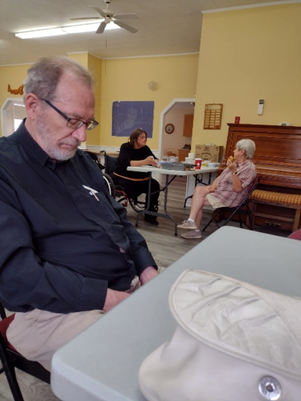


            May all your ‘other related duties’ be blessed on your journey.


Tuesday, 12 July 2022

Don’t Let a Good Catastrophe Go to Waste

Being at our cottage in Prince Edward Island, I now have a larger appreciation for how COVID is being handled in different parts of the country.  In some ways it is almost like it no longer exists – or at least it is no longer a serious problem.  It is just one of those chronic health challengers we have to live – and hopefully not die from, like the flu.

 Both back at home in Ontario and here in cottage country, there is what can only be described as a relaxed view of COVID.  Most restrictions have been lifted or at least loosened.  We have no restrictions for travelling through provinces and no quarantine requirements or testing upon arrival in P.E.I.  which has assuredly made life much easier.  There are recommendations that we wear masks in stores and public places which is observed more in the breach than in the observance.  It is very easy to go with the flow and forget about wearing one.

The application of restrictions can lead to a somewhat illogical result.  The Anglican Church here allows us to meet without masks and to sing all the verses of hymns.  However, wine is not to be received by the congregation as it would normally, and only the priest partakes of the wine.  Go figure.

 I believe that we should not let the experience of the COVID pandemic fade into the mists of our memories and not try to use that experience as we move forward both in our religious life as well as our daily life.  This was addressed recently in one of the Daily offerings from the Society of St. John the Evangelist:  

Renewal

We are in the midst of a re-creation moment. As our world continues to reverberate from this once-in-a-generation pandemic, we are confronted with the opportunity to live differently, to not let a good catastrophe go to waste, but to heed the things that the Spirit has prompted in us: outward forms of love and stewardship, and inward forms of healing and renewal.  -Br. Todd Blackham

Many in Anglican Church and other mainline religions today in the West, despair that the church is dying and there won’t be much of the church left in twenty years, if present trends continue.  The Anglican Church in my home town of Parkhill, St, James, closed at the end of June as the latest of many church closings in our Diocese.  It certainly won’t be the last.  I won’t say it begs the question, but it certainly raises the question, what will replace it?  Canadian and all of the Western world is becoming persistently more secular with the church apparently having a much less significant part in the lives of people - particularly the younger generations. 

I really don’t know the answer to that question.  However, what I do know is that something or somethings will arise to replace organized religion.  In my understanding, this will happen because it will be the work of the Holy Spirit.  That part of the Trinity in Christianity faith and dogma often does not receive as much attention as the other two parts God the Father, and God the Son.  This is, at least in part, because it is unpredictable and not under the direct control of church authorities.  This was address in one of the Daily Meditations of Richard Rohr: 

The work of the Holy Spirit, seismic and subtle, never seems to land us in a place of perfect stasis and equilibrium for long.  Rather, it teaches us to be flexible, malleable to the ongoing creation of God such that when we are confronted with an invitation to adapt, we can respond with freedom rather than resistance.

Is there some new freedom that the Holy Spirit is inviting you into these days?

‘God dwells wherever man lets him in.’  Buber, The Way of Man, 33

So, in light of this, how do we not let a good catastrophe that COVID has given us go to waste?  It is not going to be easy for many of us who have set ideas of how we should be and what we should do.  We need to have open hearts and minds and spirits to what the future holds and where the Holy Spirit (or just ‘spirt’ for the secular folks) is leading us.  We need to use our discernment in determining if something is the work of the Holy Spirit or is the work of other forces.  However, we need to be open to what lies ahead.

 May you be blessed to engage the Holy Spirit on your journey.


Tuesday, 6 August 2019

Inspiration


Last week I wrote on what could be considered the ‘news’ in the News and Views.  This week is more in the category of views – one of my favourite topics – the Holy Spirit as a source of inspiration in the church. 

The power and work of the Holy Spirit is something which seems, at least in the part of the Christian Church that I am most familiar with, not to be given much authority.  The Holy Spirit seems to be the poor relation of the family of the Trinity.  Anglicanism rests on three pillars of Scripture, Tradition, and Reason.  The Holy Spirit does not I seem to enter into any of those in a prominent way.  Perhaps it is in the background of each of these pillars.  However, it has not taken the prominent role that I believe it should.  I guess I am drawing on, what can be considered the fourth pillar, faith, in this approach.

The Holy Spirit is, of course a part of scripture being the wind that blew over the waters at the creation up to and beyond the establishment of the church on Pentecost.  It does not, however, have a firm place in the tradition of Anglicanism.  Now, this may show a lack of a firm foundation in Anglican Church history on my part and I would truly like to be educated more on this.
The place of the Holy Spirit in the Christian church is founded on the passage of scripture, John 14:16-17:
And I will ask the Father, and he will give you another Advocate, to be with you for ever. This is the Spirit of truth, whom the world cannot receive, because it neither sees him nor knows him. You know him, because he abides with you, and he will be in you. 
The direct implication of this passage is that the world was and is not ready to accept what the Spirit has come to reveal to us.  This, too, seems to be born out in the between time which began when Jesus ascended.  However, if we are to follow what Jesus has told us, we need to pay more attention to the movement of the Holy Spirit in our lives and in the world. 

I believe that the church has not given the attention to the reality and authority of the Holy Spirit because those in authority do not like the possibility that the Holy Spirit may lead people to places that they do not approve of and do not have authority over.  If regular church goers are inspired by the Holy Spirit to be the church in new ways who knows what might happen.  Therefore, let’s not let get beyond the structure and strictures that are in place.

However, despite the attempts to maintain control over the all that is the church, the Holy Spirit cannot be contained and will break though in ways that are unpredictable and unavoidable.  An example of this was noted by Richard Rohr in the past week:
Jarena Lee (17831864) was the first authorized woman preacher in the African Methodist Episcopal Church. If then, to preach the gospel by the gift of heaven, comes by inspiration solely, is God straitened; must he take the man exclusively? May he not, did he not, and can he not inspire a female to preach the simple story of the birth, life, death and resurrection of our Lord? . . . As for me, I am fully persuaded that the Lord called me to labor according to what I have received, in his vineyard. 
There are many examples of the church moving to align itself with the Holy Spirit from translating the bible into language accessible to ordinary Christians, to the movement to emancipation of slaves, to the ordination of women.

There are, of course, problems with discerning the Holy Spirit.  People can easily believe that they are being led by the Holy Spirit but in truth are being mislead by other forces or just believing what they want is actually the devices and desires of their egos.  I don’t want to minimize this reality.  People have been misled, sometimes with disastrous consequences, into following what is not the work of God.  We have to use our God given ability of discernment to move carefully into new places and in new ways.  As Jesus has told us:
Beware of false prophets, who come to you in sheep’s clothing but inwardly are ravenous wolves. You will know them by their fruits. Are grapes gathered from thorns, or figs from thistles? (Matthew 7: 14-16)
Unfortunately, it is sometimes more difficult to recognize whether it is grapes or thorns until we get to the source of them.  All we can do is to pray that God will give us ears to hear and eyes to see what is truly the will of God.

Blessings on your journey.

Tuesday, 17 October 2017

Civic Duty and Christian Duty

Last Tuesday I had to report for jury selection at the court house in London, Ontario.  I had received a summons about six weeks earlier while we were at our cottage in P.E.I.  The timing was fortunate because we had planned to return to our home here in Parkhill on Thanksgiving weekend and the summons was to appear on the Tuesday after the Thanksgiving Monday―perhaps fate or the gods were at work in that. 

This was my first experience being called for jury duty and I had mixed feelings about it.  I am very aware that serving on a jury is very important in our civil system of justice.  So, I did not resent being called. However, it did cause some disruption because, as usual, I had scheduled a lot of appointments for the first weeks back.  The information I received advised that I could be involved for two weeks so I cancelled some things and rescheduled other.  It was an inconvenience but not a serious one.  It was not as if I had to serve on a jury and lose wages which some people could find to be a serious problem as it seems more and more people live paycheque to paycheque these day.  The compensation offered by the justice system is limited and no compensation is offered for the first 10 days and then a limited amount after that.

The process itself was quite interesting and enlightening.  When I arrived, and found parking near the court house―which wasn’t compensated for―I made my way to the designated court house.  I did receive mileage (kilometrage?) as I lived over 40 km away.  I sat in the court house with all the other prospective jurors and we had the opportunity to watch an informative video about the jury system and the importance of serving on a jury as a civic duty.  It was all very positive―rather too much so―with (presumably) actors playing people who had served and found it was the most significant experience in the lives.  It was also very informative about the process of jury selection.  After that we were given a live edition of how the system works by the court administrator followed by the judge who was quite informal and who actually had a sense of humor which went against my stereotype of judges. 

We went through a very formal taking of attendance by juror number, which was on the summons along with occupation―Anglican priest in my case.  We had to declare if we were retired or not.  I was somewhat undecided as clergy don’t ever truly retire―but as I decided I was receiving a pension from the Anglican Church I was officially retired.  The jury pool had 160 people and about 140 were in attendance.  As one other members of the pool said sotto voce, I wonder what’s going to happen to the ones who didn’t show.  I imagine there would be some follow up. 

We were then advised that there was only one trial scheduled that day―a civil trial which only requires six jurors―so the odds of being selected were quite small.  There were two jurors who were selected and were peremptorily dismissed without cause and one who tried to beg off for a what seemed to be a somewhat flimsy excuse.  The judge, to his credit, did not let him off without some hard questioning and then not until after the selection process was complete.   I was not selected in the lottery which used an actual bin with the juror numbers which was spun before each ticket was drawn.  I was not selected and had clarified earlier that if we were not selected on that day I did not have to return the next day.  It was unclear if I would be part of the pool for the two-week pteroid indicated.  However, that was not the case, so I and the others were set free.  I was tempted to break out into, “free at last, free at last, thank God I am free at last,” which, of course, would have been a drastic over reaction.  I felt somewhat ambivalent but, on balance, relieved I did not have to serve on the jury of the trial which involved the London Transit System being sued by an individual.  We were not made aware of any of the other details. We were told however, that we should declare if we knew personally any of the individuals involved in the case including the witnesses. 

The process raised for me the principle of what the duty of a Christian is to the civil system.  What do we owe to Caesar and what to God?  In this case there was no conflict of course.  However, that issue has arisen many times in the past and will in the future.   Where are we called to not render unto Caesar the duty of a citizen.  What is the role of the conscientious objector?  What do we do when our duty to God conflicts with our duty to the state?  Jesus was executed by the civil authorities who were administering Roman justice which was brutal an yet was very advanced for its time.  It was done with the cooperation of the Jewish authorities.  He submitted and did not call upon the armies of angels to defeat those authorities―but that is a whole other topic or many topics for another day. 
It was an interesting experience which I am glad I had.  I am not sure I would welcome a repeat with open arms but I perhaps I shall see.


Wednesday, 31 August 2016

Change! We Don't Change, We're Anglicans

One of my favourite radios programs is This American Life on National Public Radio in the U.S.  I was listening to an episode from their archives last week about how people change their minds. 
The program reported on the rather surprizing results of an experiment in which had canvassers who went door-to-door and spent some time talking to people about controversial issues such as same-sex-marriage and abortion.  The results were quite amazing as they showed that after a relatively short period of time the people interviewed changed their minds on the issue.  More surprizing is that the change remained over a significant time period i.e. it was not just momentary.  If you are interested in listening to the program here is the link: http://www.thisamericanlife.org/radio-archives/episode/555/the-incredible-rarity-of-changing-your-mind.

One of the key factors in this result that they identified was that the interviewers had to be identified with the issue e.g. a woman who had an abortion of someone who was self-identified as LGBT.  Another significant factor that was identified is that people do not change their beliefs based on facts and data.  Where people change their minds is on the level of the gut; of visceral reactions; of emotions; of feelings (which by the way are not the same as emotions). 

They found that the most important thing that the interviewer could do in this process was to stop telling people things and to listen.  The interviewer needed to let them talk about their own lives and tell their own stories.  I would qualify that this doesn’t quite match the first finding i.e. that the interviewer needed to be identified with the issue personally.  Their experience was important. However, that information needed to be revealed in the course of the interview in context of the discussion.   The focus needed to be on the experience of the person being interviewed.
These findings were quite unexpected and surprizing because they completely overturn the expectation and common wisdom held by experts in the field.  I am wondering how these finding can be applied to that thing which Anglicans are particularly struggling with these days as we increasingly find ourselves out of step with our culture which is increasingly secular and disconnected with anything religious; That thing is evangelism.  

Today Anglicans particularly do not have experience in evangelism; in spreading the Good News of Jesus Christ.  Many other denominations have had greater experience and success in this. It was not something which, I must admit, I am very comfortable with and did not receive any training specifically on how to evangelize in school.  However, as they number of people in the pews dwindle; as our parishioners get older; and as more and more churches close it is something we need to turn our attention to.  It is not just a case of survival as the Anglican Church in Canada and perhaps all the Western world.  It is also an imperative as Christians.  We are called to spread the Good News of Jesus Christ to the world.

I must qualify the above by saying that I am not comfortable about evangelization when I think of it in traditional way of thinking about evangelization.  The picture I have is of the T.V. evangelist who would play on the audience’s fears and desires and prejudices, or the people at the door who ask if I have been saved or born again.  That is key to the issue and where it intersects with the findings discussed in that radio program.  We need to redefine what evangelism means.  We need to share the Good News by approaching people where they are and listening to their experience.  We also need to be able to share our stories and how being an Anglican is part (hopefully an important part) of our stories as Christians. 


Actually that is pretty much what I do as a Spiritual Director.  I listen to the experience and stories of my directees and share how my experience has helped me to have a closer relationship with God.  This week I invite you to reflect on your experience of being an Anglican or Roman Catholic or United Church member or as a spiritual person unconnected to organized religion and how that has affected your life.  What would you say to share that with someone you just met?